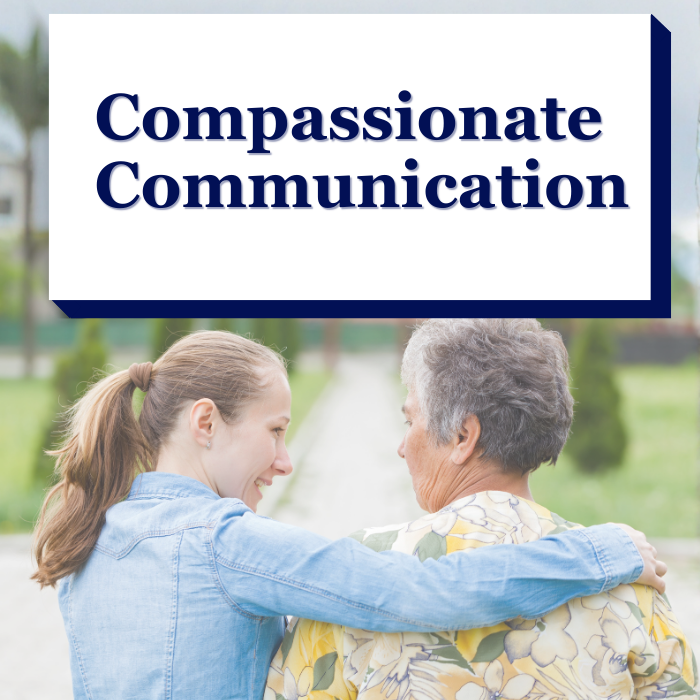
Communication begins to shift long before memory loss becomes obvious, and for many families, it’s one of the hardest parts of the Alzheimer’s journey.
As words fade and conversations feel less predictable, frustration can rise on both sides. Compassionate communication offers a calmer path, rooted in patience, connection, and respect, creating moments of understanding even as language changes. It not only eases daily interactions but also preserves dignity and strengthens the emotional bond at the center of caregiving.
What to Avoid
- Reasoning or long explanations
- Arguing or correcting their beliefs
- Confronting or challenging them directly
- Reminding them that they forget
- Testing or questioning recent memory
- Taking things personally
What Helps
- Give short, one sentence explanations
- Repeat instructions the same way each time
- Allow extra time for comprehension
- Agree with them or gently redirect
- Step away briefly to avoid confrontation
- Accept the blame when something is wrong (even if it is a fantasy)
- Respond to the feeling rather than the words
- Be patient, cheerful, and reassuring
- Be generous and gracious
Things to Keep in Mind
- They are not crazy or lazy. Their behavior is normal for someone with memory loss. If they were doing or saying things to deliberately aggravate you, they would have a different diagnosis.
- Some days they seem normal but they are not. Their reality is now different than yours, and you cannot change or control the disease. You can only control your reaction to what it does to them.
- Their disability is memory loss. They cannot remember, and they cannot remember that they cannot remember. They will ask the same question repeatedly, thinking it is the first time.
- They do not hide things. They “protect” them and then forget where they put them. Do not take it personally when they accuse you of stealing.
- They live with constant fear. Each person reacts differently to fear. They may become passive, uncooperative, hostile, angry, agitated, verbally abusive, physically combative, or clingy. They may do all of these at different times – or alternate between them.
- They cannot remember your reassurances. Repeat calming messages as often as needed.

Quick Reference Examples
Situation: Resisting an appointment
Patient: “What doctor’s appointment? There’s nothing wrong with me.”
Don’t reason: “You’ve been seeing the doctor every three months for the last two years. It’s written on the calendar and I told you about it yesterday and this morning.”
DO:
(Offer a short explanation) “It’s just a regular checkup.”
(Accept blame) “I’m sorry if I forgot to tell you.”
Situation: Pushing caregiver away
Patient: “Nobody’s going to make decisions for me. You can go now…and don’t come back!”
Don’t confront: “I’m not going anywhere and you can’t remember enough to make your own decisions.”
DO:
(Respond to feelings) “I’m sorry this is a tough time.”
(Reassure) “I love you and we’re going to get through this together.”
(Redirect) “You know what? Don has a new job. He’s really excited about it.”
Situation: Needing reminding
Patient: “I’m going to the store for a paper.”
Don’t repeat differently: “Please put your shoes on…You’ll need to put your shoes on.”
DO:
(Repeat exactly) “Please put your shoes on…Please put your shoes on.”
Situation: Saying a loved one hasn’t called
Patient: “Joe hasn’t called for long time. I hope he’s okay.”
Don’t remind: “Joe called yesterday and you talked to him for 15 minutes.”
DO:
(Reassure) “You really like talking to Joe don’t you?”
(Redirect) “Let’s call him when we get back from our walk.”
Situation: Accusing of stealing
Patient: “I didn’t write this check for $500. Someone at the bank is forging my signature.”
Don’t reason: “What? Don’t be silly! The bank wouldn’t be forging your signature.”
DO:
(Respond to feelings) “That’s a scary thought.”
(Reassure) “I’ll make sure they don’t do that.”
(Redirect) “Would you help me fold the towels?”
Situation: Forgetting a caregiver
Patient: “Who are you? Where’s my husband?”
Don’t take it personally: “What do you mean—who’s your husband? I am!”
DO:
(Go with the flow, reassure) “He’ll be here for dinner.”
(Distract) “How about some milk and cookies?…Would you like chocolate chip or oatmeal?”
Situation: Refusing a meal
Patient: “I’m not eating this. I hate chicken.”
Don’t say “but”: “I know chicken’s not your favorite food, but it’s what we’re having for dinner.”
DO:
(Say nevertheless) “I know chicken’s not your favorite food, (smile) nevertheless I’d appreciate it if you’d eat a little bit.”
Situation: Forgetting a person
Patient: “Hello Susie, I see you’ve brought a friend with you.”
Don’t question memory: “Hi, Mom. You remember Eric, don’t you?…What did you do today?”
DO:
(Offer short intro) “Hi, Mom. You look wonderful! This is Eric. We work together.”
“Once dementia is diagnosed, the patient is excused 100% of the time.”
Alzheimer’s: A Handbook for the Caretaker by Eileen H. Driscoll, R.N.
You can also download a printable version of this here: Compassionate Communication (Yellow Sheet)
Adapted from materials by Liz Ayers of the Alzheimer’s Association. This guide is intended for caregiver education and nonprofit distribution. Always consult a healthcare professional for individualized medical guidance.
Learn More About Dementia: